Talk
AI for small business
The talk as delivered, from the speaking script, with the slides beside it. Twenty minutes on what an LLM actually is, where the technology stops, and the five hires it gives a small business owner.
A sample of the narration
The narration is a synthetic clone of John's voice, generated in-house. We built it; it seemed only fair to say so.
Oak City Intelligence

Thank you for having me. Some of you know me — I was in the first cohort of Launch Holly Springs. I owe a lot to Launch Holly Springs and the business incubation program teaching me most of what I know about the backend of business. My original venture didn't pan out, but I found success in freelance developer work and utilized all those skills. Along the way I got deep into the AI tools in my development stack, which led me to create Oak City Intelligence — the platform I'll use as a case study today to talk about what AI can do for small businesses, and the path forward I see from my point of view. I come to you as a developer of AI products and a consultant, to share insight about what small business AI integration looks like in practice today and tomorrow.
The Boogeyman

From what I have seen — and it may be a biased sample — there is a lot of rhetoric about AI taking jobs, replacing people, dismantling the fabric of society as we know it, and gaining consciousness and taking over the world to create as many paperclips as possible. Maybe you've heard a version of this — it's the sensational, clickbait version of the situation.
AI consciousness is not coming — not from this inference architecture.

I'd like to offer the nuanced and balanced version, and stick my neck out to make a claim: AI consciousness is not coming — not from this inference architecture, and we'll define what that means in a minute. And though the workforce will certainly continue to shift from the use and integration of AI in practice, it is not a done deal. In fact, AI — and hence agents — have a lot of fundamental drawbacks that are preventative to this. I'd like to present them to you, in order to touch briefly on what exactly "AI" is.
VOCAB: LLM, Inference, Context, Agents

So let's first start at what exactly AI is. We are going to define four terms: LLM, Inference, Context, and Agent. Learning what they are and how they are made makes it clearer what this technology can and can't do — and by the end, how to actually integrate it into your small business.
LLM: a giant spreadsheet of "weights"

First of all, the AI itself — maybe you've heard it called a model. Maybe you've seen the acronym LLM, which stands for Large Language Model. Well, what is the model actually? The flagship models — OpenAI's GPT, Anthropic's Claude — are closed source private, but there are open models you can go and download right now. If you were to take these downloaded model files on your computer and open it up in a text editor to see the actual contents, it would essentially be a twelve-gigabyte spreadsheet filled with seemingly random numbers. These are called weights, and these are the fabrications that these companies are spending all their money "training." Isn't that a marvel — that this technological product is a giant matrix of numbers? We'll talk about training after we touch on inference and then a little bit of hardware.
Inference

So now that we have this giant spreadsheet of random numbers, let's do some inference — which is the artificial intelligence act itself. It is a computer program engineered to use the provided weights to INFER the next word. Like autocorrect. Take the model, load it in an inference program, give it a sentence: "The rain in Spain falls mainly on the ___." The program "tokenizes" the words in the sentence into numbers, which are then calculated against the model weights to produce a probabilistic solution of what is the most likely best next token. Who remembers linear algebra and matrix multiplication? That is the deepest we get into the tech in this talk, and I am happy to take any questions after for anyone looking for more. All we need to remember is that at the end of the day, it's matrix multiplication on a spreadsheet to perform fancy autocorrect.
Same math as your screen.
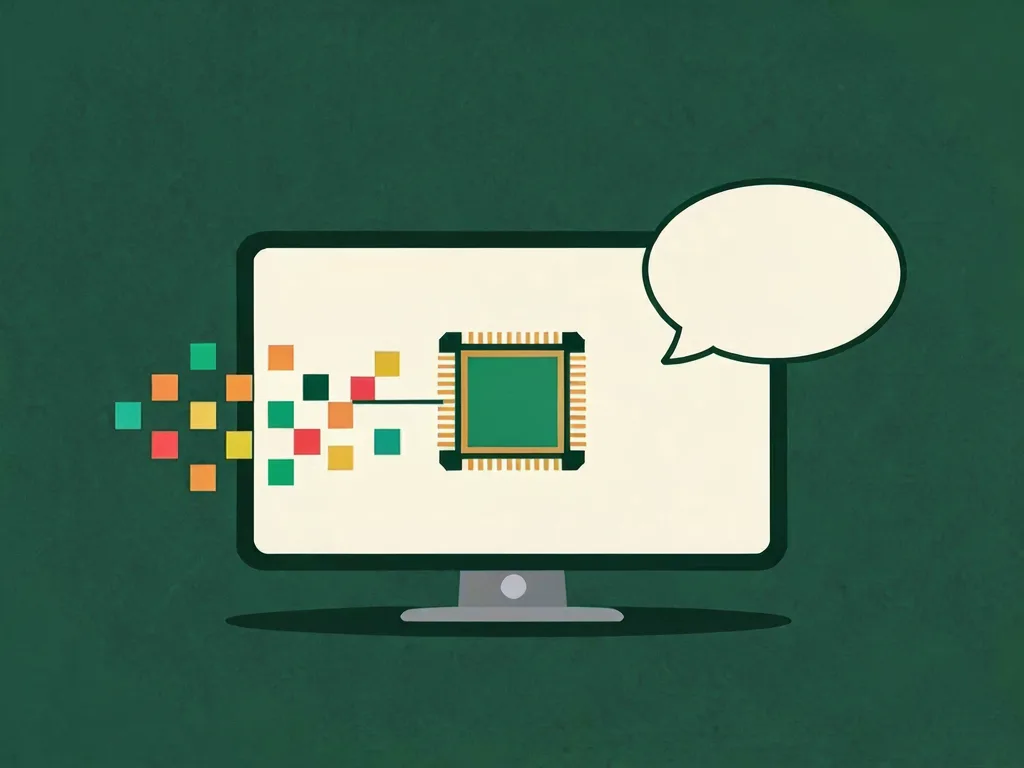
Here as an aside, now we have a little insight as to why a graphics card — GPU — designed to update the pixels of your computer monitor or TV very quickly over and over, is incidentally the perfect chip to run inference on.
Context

All of this has been greatly oversimplified to save the headache, but it sets up the most practical definition of the four: context. Context is everything you input into the inference program, and it is limited — your question, the conversation so far, any documents you give it. Put simply, the AI can only keep so many words in its head at once, as a law. If you have ever had a conversation run long enough with an AI chatbot, you may have noticed it forget some details, or get a little off track from the original idea. That's because behind the scenes, the chat application has been "compressing" your context — basically summarizing the conversation so far to itself, so that you can continue to chat without interruption. It's one of the main focuses of innovation at the framework level — different strategies for managing context. And it's a driver for the AI companies to go bigger and bigger with their models, to support larger and larger context limits. Just knowing this simple fact about how the technology works will already help you get more out of it.
Pre-training → Post-training → Reinforcement learning

Okay — we now know a little about how AI works under the hood, which informs how the models are created. This is just a little insight to help frame the differences between Claude, ChatGPT, and the other models — what makes them different, and what makes them so expensive besides having to run on a giant datacenter somewhere. Models are trained kind of like how I'm teaching my two-year-old new words. We read a book he knows, and try to let him finish the sentence. If he knows it, he shouts the word and we praise him. If he doesn't, we tell him, and he gets it next time. Training an AI is basically that, a trillion times — and instead of Dr. Seuss, it's the entire internet, spelling mistakes and false information included. That part is called pre-training, and it gives you a super-autocorrect — raw and unrefined. Then you go back, and instead of the entire internet, you have the model focus on curated sources — scientific material, poetry, and the like. And after that, you train it how to behave: teaching it manners, and how to be a chatbot. Those parts are called post-training and reinforcement learning. This is where the art is — it's the personality difference you feel between ChatGPT and Claude, the training philosophy of the company getting imbued into the intelligence. Some people find they prefer how different models approach tasks, and it's fun to experiment and compare. After we define agents next, the nerdy part will be over — you've been very patient.
Agents

So, "agents" — probably still the most exciting definition buzzword being thrown around right now, and rightfully so, because this is where the LLM goes beyond a chatbot and starts doing work. But it's not magic. It's the same inferring-words as before, but put into the right framework, where the words themselves are commands in a computer sandbox. So, putting it all together: you ask ChatGPT what the weather is. Its reinforcement learning steers it toward guessing not the next word in your sentence, but the next word in your conversation — from itself, as the other participant — and it infers a command that comprises an internet search. It summarizes that result and returns it to you, with sources. Big leap — but really nothing we hadn't covered, if you can believe that. Now let's look at where that leaves us today.
An alien technology. So what's the catch?

So: an alien technology that can practically read our thoughts, and it can do anything we can do on our computer. What's the catch? First, it can only keep a train of thought roughly half a million words long. Second, the price of progress is staggering: the cost of training these frontier models has been growing two to three times every year — GPT-4 reportedly cost over a hundred million dollars, and the industry is now talking about billion-dollar training runs. Each of those leaps buys an improvement, not a revolution. And third — most important of all — remember those three stages of training? The raw-internet stage is where nearly all the computation goes. The expert refinement on top has historically been around one or two percent of it. So although it was trained on experts, it was trained on the average most of all. For it to accomplish anything valuable, someone with actual intelligence has to tell it what to do.
AI cannot produce anything exceptional without a human. It can only reiterate what is commonplace.

If you take nothing away from this talk but one thing, it's this: AI cannot produce anything exceptional without direct human intervention — it can only reiterate what is commonplace.
Billions in capex. Subsidized for you.
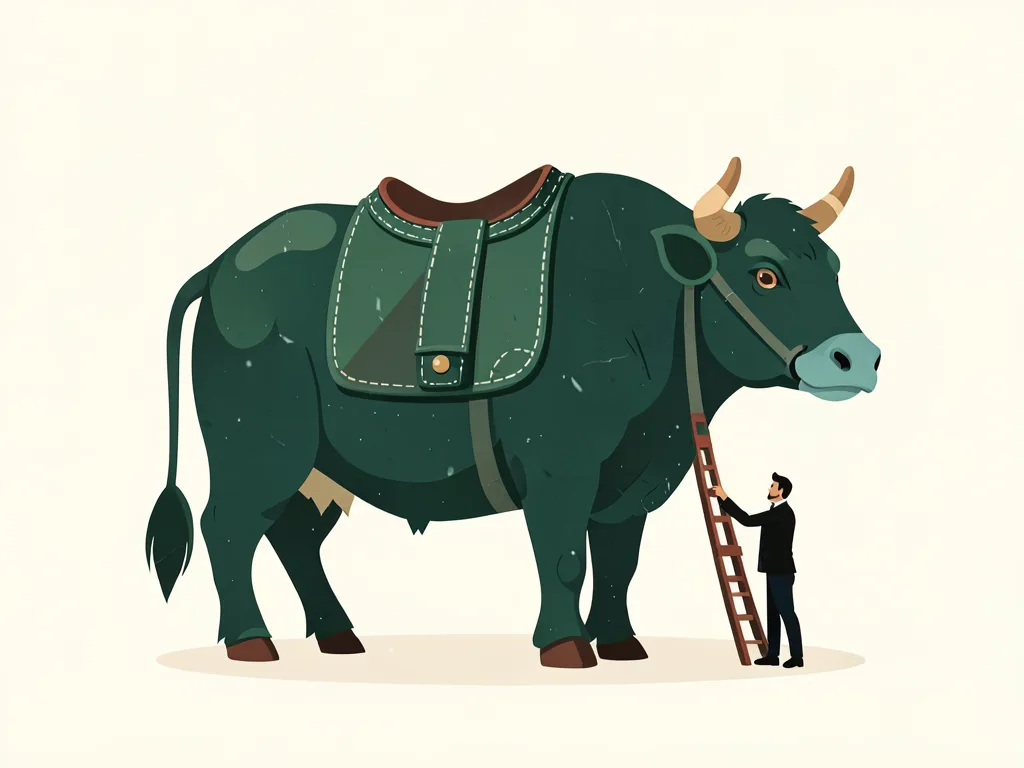
An LLM — by virtue of the fact that it was trained on everything — may know some subjects better than you outside of your specialization, which can make it really helpful as an unaccountable sounding board. But it will never be able to do anything right unless you, or someone, tells it how. Every AI-as-a-service platform out there is selling the same thing: they found the words that get an acceptable result for a broad enough audience. Meanwhile the technology underneath — the one we now understand together — is sitting on billions of somebody else's capital, and you get to use it essentially subsidized. Getting exactly what you need out of it is a skill — but think about what's on the other side of that skill: a machine that cost billions to build, yours for the price of a cup of coffee. The only question left is what to point it at.
The ladder

Since we know what LLMs are, now the strengths and weaknesses start to inform us about where it is applied best in your business, so we can get to work. By itself, and instructed properly, it can improve your website, write blog posts that get you found on Google, social media posts; it can be a sounding board for you, working out ideas and their feasibility; it can gather information from the internet. You can do most of these as one-offs in 15 minutes using a chat interface like ChatGPT, Claude AI, et cetera. With your help, it can write proposals, make designs and assets for letterhead; it can perform communications, copywrite, proofread, and scope new features. Given enough arm-twisting and careful consideration, it can do things like filling out forms, generating leads, sending email campaigns — and even answering the phone. This is where the state of the art is now. Remember, because of its agentic abilities, if it's something someone can do on a computer, you can be almost certain an AI can do it, or learn how.
Your job is validation.

But with every task that you ask of AI, your job and priority — as the ensouled participant — is validation. Is the result good enough? Can you take it and make it great? Is it worth it? Those are your considerations when shopping for integrations for your business.
A new interface for computers — skip the apps, speak the result into existence.

Maybe you've already gotten some experience with the chat tools and done some of these for yourself — I hope you have, or that you're ready to give it a try, because it is so much fun. But to contrast against the examples I provided: in each of those cases, you yourself will do a better job than the AI, given enough time and effort. The bargain is in the elimination of the learning curve. Another way I like to think of AI is that it's a new interface for computers — skipping the app layer entirely, letting you simply speak the results into existence in plain English.
Sometimes the best AI integration has no AI in it.

Another thing to remember: the AI is probabilistic, and it is often the wrong tool for the job. Sometimes the best way to integrate AI into your business is to use it to make something totally devoid of AI — like an online booking form — plain, deterministic software that does the same thing every single time. The AI was the power tool that built it for a fraction of the price; it doesn't have to live inside the finished product. Because from where I sit, the most common way I see entrepreneurs waste their time is rushing to bolt AI on for its own sake — a chatbot on the website nobody asked for, making up answers about your own prices — installing AI where a form would do.
The five hires AI gives you.

We now know the nature of AI, we know about its limitations and why it hasn't taken over the world. But what is it doing now to change the lives of small business owners, and where does it live up to the hype? It goes back to the concept of context we were talking about before: AI is great at role playing, and if you load it up with enough context to have it pretend to be a bookkeeper, a marketer, an office manager, a tech guy, an assistant — it does a really good job.
For some, hiring all of these is not in the budget. But driving an inference system that can approximate them is a big step up. AI can't be held accountable — they can't replace those actual hires — but they can get you the support that can make a big difference. I think of them as the five hires AI gives you when you use it as a small business person. Let me tell you how to set them up.
The bookkeeper

First off, a bookkeeper — or really just someone invested in keeping you organized and on track. The lift here is just getting set up so that your AI has effortless access to the necessary materials, without you chasing down papers and scanning them. There are services that connect your bank accounts read-only — safely, for a few dollars a month — and whatever you already use for payments and accounting almost certainly plugs in too.
Once you complete that hookup, you have a bookkeeping genie that can prepare reports, queries, projections, and help you keep on top of all your obligations — maybe even shining a light on where the budget can tighten up. Absolutely worth starting here. And if you're doing your books yourself and it feels like you're missing something, this second opinion can give you peace of mind.
The marketer

Next up, the marketer. Marketing really includes any outward-facing surface of your business — outreach, advertising, your website, social media, mailing lists, content writing. This is a really strong area for AI, but the trick is to hide the fact that AI produced it.
The lift here is setting up a body of work to draw from: guidance on how to post, who the audience is, what data you have about what has gone well so far. The best way to set this up is to have campaigns, a review queue for your eye, and connections to your outbound channels — Facebook, TikTok, Instagram, email, the blog — so they fire off and you get to just be moderating. Yes, it can even do video — though in most cases you're better off using real footage, and AI can actually help you edit it.
The office manager

Third, the office manager — and this one is the connecting glue for the other hires. It's less about any single task and more about a discipline: surfacing the right things at the right time. The lift here is customization — teaching it how you like to work, and building up its memory of your situation: your CRM, your goals, what's in flight, what's stalled. You keep that memory current the way you'd keep a good employee in the loop, and hooking up email reading helps it stay current on its own.
It sets reminders, sure — but the real value is that it talks to the bookkeeper and the marketer, holds the whole picture, and each morning hands you the two or three things that actually deserve your attention. It's the difference between a pile of tools and a staff that compares notes.
The tech guy

Fourth, the tech guy. AI is remarkably good at writing software — that's the job it's changed most. Start with what you can do yourself: ask it to update your website, fix the wording, add a page. It'll walk you through it. A step up, you can have it build small tools — an appointment scheduler, a quote calculator, a price sheet that updates itself. And here's the fun one: those other hires I just described? This is the hire that builds them. The bookkeeper hookup, the marketing queue, the office manager's memory — that's all software, and AI writes it now.
The honest part: past a certain point this takes experience — knowing what to ask for, wiring the pieces together, keeping it running. That's the lift, and it's the one we provide.
The assistant — deals with other people for you.

Last one, the assistant — the hire that deals with other people for you. Drafting replies, chasing appointments, following up on the quote you sent last week. And for a lot of businesses the single most valuable version of it is answering the phone. If you're a plumber or an electrician, you're up a ladder at two o'clock and the phone rings — that missed call is a customer calling the next name on the list.
This is the one we took all the way. We call it Concierge: the same AI you now understand, with the context loaded, the guardrails set, and one job — answer the phone, be helpful, book the appointment. Rather than describe it, I'd like you to hear it.
Let's hear it.

This is our own line — the one Oak City Intelligence answers with. Let's call her right now, ask some questions about us, and see if she can get us a meeting.
At this point in the talk, John placed a live call from the room to the Oak City Intelligence phone line, which Concierge answers.
Three things to take home.

So let's land this. If you remember three things from today, make it these. One: AI is not magic and it is not a mind — it's a probability machine that reiterates the commonplace, and the exceptional part is always a person pointing it. Two: your job is validation — is it good enough, can you make it great, is it worth it. Three: think in hires, fill the context with what role you want it to play — a bookkeeper, a marketer, an office manager, a tech guy, an assistant — each one a real step up, and each one just needs setting up.
Go play with the chat tools — it's fun, and it's free to start. Keep your skepticism; it will serve you well. And if you want help with the setting-up part, come find me — the conversation is free. Launch Holly Springs and this community gave me my start; I'd love to return the favor. Thank you — I'm happy to take questions.
Take it with you.

Point once: that code is my card — my contact, the free consultation, and the number of the AI you just heard, so you can call her yourself on the drive home.